
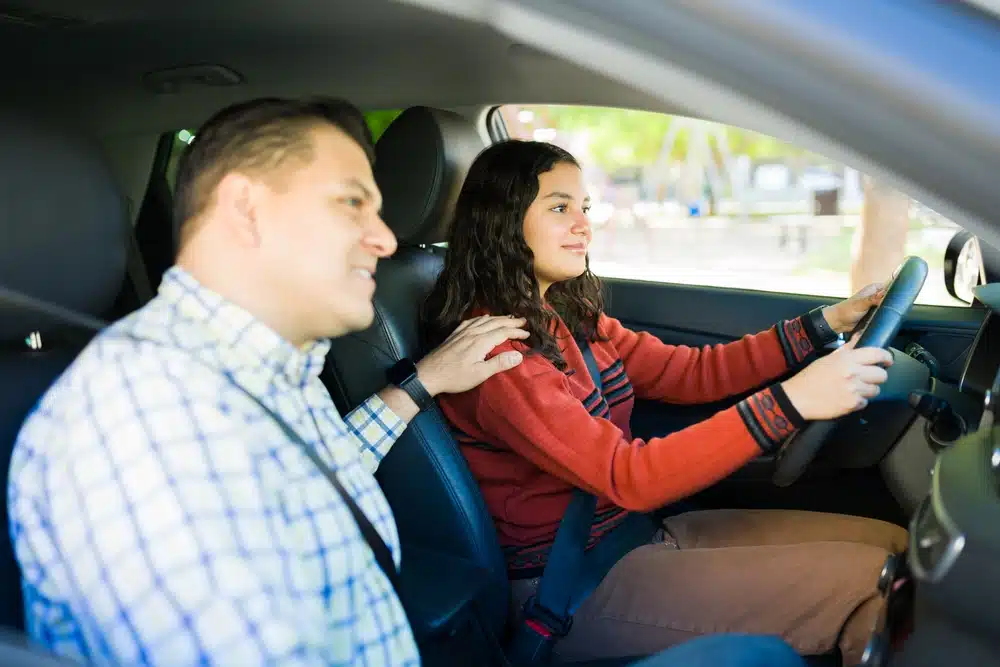
Practising driving is an important part of the journey towards getting your driving licence. Driving gives you valuable experience behind the wheel and makes your training both safer and more affordable. There are clear rules for when and how you can practise driving.
Here's an overview of what's required and how you can make the most of your practice.
When can you start practising driving?
To practice driving a car, you must be at least 16 years old. If you are under 25 years old, you must also have completed a basic traffic course. Once the course is completed, you will receive a certificate that allows you to practice driving. This certificate, along with valid identification, must always be in the car when you are driving.
If you are over 25, you will be exempt from most of the course, but you will still need to have identification with you while driving.
Requirements for supervisor and vehicle for practice driving
The companion must have held a car driving licence for five consecutive years and be at least 25 years old. It is the companion's responsibility to monitor and ensure the driving is safe. The companion must also be sober and attentive throughout the journey.
The car must be in good technical condition and marked with a visible red L-sign at the back. Although not a formal requirement, it is recommended to have an extra mirror in the car for the accompanying person. This makes it easier to keep track and intervene if necessary.
Normal car insurance also applies during supervised driving, but it's worth checking if the insurance has age restrictions for who can drive the car.
This must be in the car
It's easy to forget, but you must always bring:
- Proof of completed basic traffic course (if you are under 25 years old)
- Valid identification
- The companion must bring their driving licence
If something is missing, it may lead to fees or you having to end your drive. Therefore, it is advisable to have a regular routine for checking this before you set off.
What should you train for?
Many start on quiet roads, practising basic skills such as setting off, hill starts, gear changes and braking. Gradually, it's advisable to practise driving in towns, roundabouts, parking and at higher speeds. You should also gain experience driving in the dark and in varying conditions.
To get the best possible outcome, it's smart to have a plan for what you'll practice each time. The sessions should be tailored to your level. Practice often and in different situations, and include reflection after your outings. What went well, and what can be improved? This makes learning more effective.
Driving practice and driving lessons
We are happy to recommend that private driving practice be combined with lessons at a driving school. In fact, it's an advantage. At the driving school, you receive systematic training and clear feedback. Many find that what they learn from the driving instructor makes it easier to know what to practice at home.
The instructors at Oslo Team Driving School will also provide guidance on how to make the best use of private driving. The training is adapted to you as a student, and provides good interaction between theory, practice, and experience.
Get started the right way
When you follow the rules and build experience at your own pace, you lay a good foundation for the run-up.
Would you like to know more about how to get started, or would you like to combine practicing at home with driving lessons with us?
Oslo Team Trafikkskole will be happy to help you further!